
Tampa Bay · West-Central Florida
Armadillo Removal & Burrow Control in Tampa Bay, Florida
Waking up to fresh holes punched through your St. Augustine grass, or a burrow tunneled under the slab or A/C pad? Nine-banded armadillos are one of the most destructive yard pests in West-Central Florida. We trap the animal, close the burrow, and take steps to keep the next one from moving in.
How to know it's an armadillo
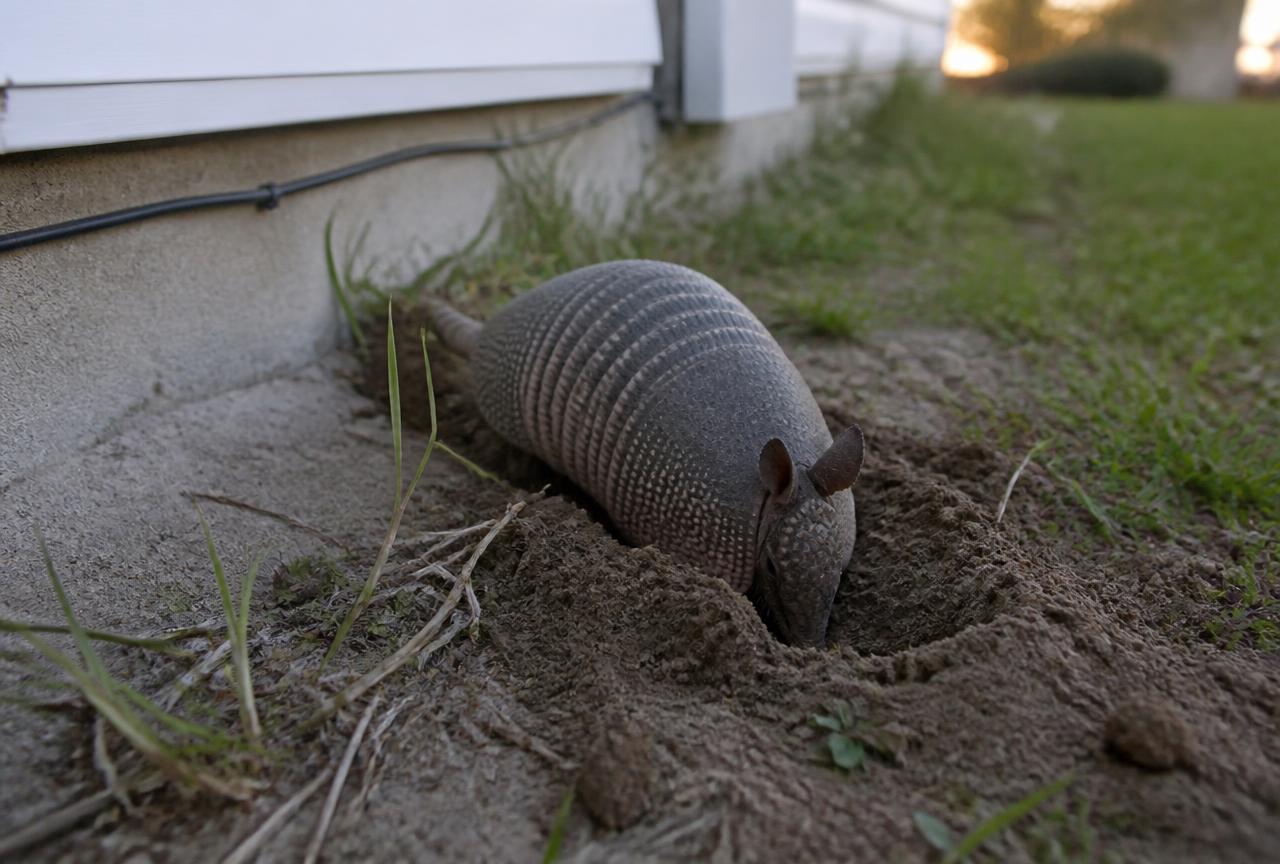
Armadillo damage looks different from mole or rodent activity: shallow cone-shaped divots two to four inches across, scattered across the lawn overnight, with the sod flipped rather than tunneled. Burrow entrances are seven to ten inches wide, usually tucked against a foundation, deck, shed, A/C pad, or under thick shrubs. Armadillos are near-blind, nocturnal, and follow the same feeding routes every night — which is exactly what makes trapping them effective.
Why burrows are the real problem
The nightly lawn digging is cosmetic. The burrow is not. Armadillo tunnels run up to fifteen feet and can undermine slabs, walkways, pool decks, septic drain fields, and A/C pads, and they create ready-made entry voids that rats, snakes, and yellow jackets move into next. Removing the armadillo without addressing the burrow leaves the structural problem — and the vacancy — behind.
Our armadillo removal process
1) Evening inspection to identify active burrows, travel routes, and the grub-rich sections of turf drawing them in. 2) Placement of live traps with wing barriers along those routes — armadillos will not enter a trap sitting in open lawn. 3) Daily trap checks and legal relocation or dispatch per FWC rules. 4) Burrow collapse and backfill so it can't be re-occupied. 5) Recommendations on barrier trenching, footer screening, and lawn grub treatment to remove the food source.
Keeping them from coming back
Armadillos come for soil invertebrates: grubs, worms, and beetle larvae. Yards on irrigation with soft, moist, grub-heavy soil get hit repeatedly, and clearing one animal from a good feeding ground just opens it for the next. Long-term control combines burrow closure with buried barrier fencing at decks, sheds, and A/C pads, and grub reduction in the turf itself.
Frequently Asked Questions
Can I just fill in the hole?
Not while the burrow is active — you may trap the animal underneath, and armadillos typically reopen a backfilled tunnel within a night or two. The animal comes out first, then the burrow gets collapsed and filled.
Do repellents or granules work on armadillos?
In our experience, no. Castor-oil granules, mothballs, and ultrasonic devices don't reliably move an armadillo off a productive feeding ground. Trapping the animal and closing the burrow is what actually resolves it.
How long does it take to catch one?
Most armadillos are caught within two to five nights once traps are set on an active route. Multiple animals or several burrows on one property can take longer.
Do you repair the lawn damage?
We collapse and backfill burrows and level the digging. Full re-sodding of heavily torn-up turf is usually left to your lawn service — we'll tell you what needs replacing.
What areas do you cover?
Hillsborough, Pasco, Pinellas, Hernando, and Polk counties, including Tampa, Brandon, Wesley Chapel, Lutz, Land O' Lakes, and Plant City. We're reachable 24/7 at 813-638-6017.
Need armadillo removal in Tampa Bay?
Gotcha Wildlife Removal is on call 24/7 across Hillsborough, Pasco, Pinellas, Hernando, Polk counties.
Call 813-638-6017Armadillo Removal by city
- Armadillo Removal in Tampa
- Armadillo Removal in Brandon
- Armadillo Removal in Riverview
- Armadillo Removal in St. Petersburg
- Armadillo Removal in Clearwater
- Armadillo Removal in Wesley Chapel
- Armadillo Removal in New Port Richey
- Armadillo Removal in Spring Hill
- Armadillo Removal in Brooksville
- Armadillo Removal in Lakeland
- Armadillo Removal in Winter Haven